Learn It. Practice It. Certify It. Work It. Build a Future.
Heaven-Sent's planned Safe Harbor Workforce Academy is designed to turn housing stability into opportunity—combining classroom instruction, hands-on training, supervised work experience, credential pathways, employment readiness, and real-world service.
The Academy is intended for Veterans, people with disabilities, people experiencing homelessness or housing instability, youth and young adults, people returning to the workforce, second-chance participants, seniors seeking appropriate purpose or re-entry, and other eligible participants ready to build practical skills and move toward sustainable employment, apprenticeship, continuing education, or entrepreneurship.
More Than Classes: A Path From Instability to Skill, Credential, Work and Advancement.
Safe Harbor is being designed so workforce development begins before the first class and continues after placement. The Academy's role is to help remove barriers, assess goals, teach foundational and occupational skills, document competency, connect participants to recognized credentials and qualified apprenticeship or education partners, engage employers, support placement, and follow retention and advancement.
1. Barrier Removal
Housing, food, hygiene, transportation, documents, digital access, disability accommodations, family barriers and other practical issues that can prevent attendance or employment.
2. Career Assessment
Interests, prior experience, transferable skills, literacy/digital needs, work history, accommodations, goals and realistic occupational pathways.
3. Foundational Skills
Workplace communication, digital literacy, math, reading, safety, financial literacy, time management, teamwork and job-readiness fundamentals.
4. Occupational Training
Classroom instruction, labs, demonstrations, supervised projects and practical skill development in selected career tracks.
5. Credentials
Preparation for recognized credentials where appropriate and available through qualified providers, with clear distinction between training, certificates, certification and occupational licensure.
6. Work-Based Learning
Supervised campus projects, job shadowing, internships, pre-apprenticeship, on-the-job learning or other lawful work-based learning arrangements developed with partners.
7. Placement
Employer connection, applications, interviews, apprenticeship referrals, continuing education, job matching and entrepreneurship resources.
8. Retention & Advancement
Follow-up focused on attendance, transportation, workplace barriers, credential progression, wage growth, additional training and long-term stability.
A Bed Is Not the Finish Line.
Safe Harbor is being designed around a simple truth: people need more than a temporary place to sleep. They need a path toward stability, confidence, income, community, and purpose.
The Workforce Academy brings housing, casework, life skills, workforce development, and hands-on experience together so participants can learn in a supportive environment while preparing for real employment.
Programs are intended to combine classroom learning with supervised practical experience. Where a trade is regulated, licensed or appropriately credentialed professionals will provide or supervise instruction and work as required.
One System. Six Practical Steps.
Training Works Better When Life Is Stable Enough to Learn.
Housing Stability
Planned dorm, transitional, accessible, family, and other housing options are intended to reduce the daily instability that can derail training.
Meals & Basic Needs
Safe Harbor's planned food-service model supports regular meals, hygiene, laundry, clothing, and basic-needs stability.
Casework & Benefits
Participants can receive support navigating documents, housing, transportation, Veteran resources, disability services, benefits, and referrals.
Employment Readiness
Resume development, interviews, workplace expectations, communication, digital skills, job search, and employer connection.
What Participants May Actually Learn.
The following is the Academy's planned instructional framework. Final course offerings, hours, prerequisites, instructors, credentials and delivery partners will be established during program development and may vary by participant, occupation and funding source.
Core Workforce Foundation
- Workplace communication
- Attendance, punctuality and reliability
- Teamwork and conflict resolution
- Workplace professionalism
- Career exploration and goal setting
- Resume and application preparation
- Interview practice
- Job-search strategy
- Digital job applications
- Workplace rights and responsibilities awareness
Safety & Emergency Readiness
- General jobsite safety
- PPE selection and use
- Hazard recognition
- OSHA 10/30 pathways where appropriate
- First Aid / CPR / AED through qualified providers
- Fire safety
- Emergency procedures
- Heat and weather safety
- Tool and equipment safety
- Incident reporting
Construction Foundations
- Construction math
- Measurement and layout
- Blueprint fundamentals
- Hand and power tools
- Material identification
- Jobsite organization
- Carpentry foundations
- Masonry/concrete foundations
- Painting and surface preparation
- Apartment/facility maintenance
Building Systems
- Electrical safety and basic circuits
- Devices and components
- Plumbing fixtures and piping concepts
- Leak identification
- HVAC system components
- Airflow and preventive maintenance
- Filters and coil care
- Work-order systems
- Preventive-maintenance scheduling
- Regulated work only under required licensure/supervision
Automotive & RV
- Shop safety
- Vehicle inspection
- Preventive maintenance
- Tires and brakes
- Batteries and charging systems
- Fluid systems
- Basic diagnostics
- RV electrical concepts
- RV plumbing concepts
- RV appliances and components
- Repair documentation
Small Engine & Equipment
- Fuel and ignition concepts
- Generators and pumps
- Mowers and outdoor equipment
- Inspection and tune-up
- Preventive maintenance
- Equipment pre-operation inspection
- Spotter communication
- Site awareness
- Material movement
- Operator credentials through qualified partners where applicable
Transportation & CDL Preparation
- Commercial vehicle safety
- Pre-trip concepts
- Hours-of-service awareness
- ELD/logbook concepts
- Route planning
- Cargo awareness
- CDL knowledge preparation
- Referral to compliant CDL providers
- Fleet operations
- Disaster transportation concepts
Warehouse & Logistics
- Receiving
- Shipping
- Put-away and picking
- Inventory systems
- Pallet/material handling
- Warehouse safety
- Supply accountability
- Distribution operations
- Purchase orders
- Vendor communication
Culinary & Food Production
- Kitchen safety and sanitation
- Knife and cooking techniques
- Food preparation
- Menu planning
- Portion and cost control
- Baking and desserts
- Batch production
- Packaging and labeling
- Institutional/disaster feeding concepts
- Food-safety credential preparation
Hospitality, Retail & Customer Service
- Professional communication
- Front-desk procedures
- Reservations/check-in
- POS systems
- Merchandising
- Customer-service problem solving
- Basic supervision
- Scheduling
- Campground/recreation operations
- Emergency guest procedures
Grounds, Pools & Outdoor Skills
- Turf and landscape care
- Mowing and edging
- Irrigation basics
- Plant/soil fundamentals
- Equipment safety
- Pool water testing
- Filtration concepts
- Pool/spa maintenance
- Outdoor safety
- Fishing and conservation
- Environmental stewardship
Technology — Skully Ryan Lab
- Computer fundamentals
- Internet and digital safety
- Word processing
- Spreadsheets
- Document creation
- Online applications
- Remote-work readiness
- Basic troubleshooting
- Entry-level technology credential pathways where appropriate
Financial Capability
- Budgeting
- Banking basics
- Bills and recurring expenses
- Credit awareness
- Saving
- Benefits and earned-income coordination
- Housing budgeting
- Transportation budgeting
- Taxes and payroll awareness
- Independent-living financial planning
Entrepreneurship & Small Business
- Business-model basics
- Customer discovery
- Pricing and costs
- Basic bookkeeping
- Marketing fundamentals
- Licensing awareness
- Insurance/risk awareness
- Contracting basics
- Business-plan preparation
- Referral to SBA and qualified small-business resources
Disaster Service & Community Resilience
- Preparedness and team structure
- Mass-care concepts
- Shelter support
- Disaster feeding
- Warehouse/logistics
- Distribution operations
- Damage-assessment fundamentals
- Documentation and reporting
- Emergency communications
- Licensed amateur-radio pathways where applicable
Independent Living & Stability
- Household routines
- Meal planning
- Hygiene and self-care
- Transportation planning
- Appointment management
- Communication
- Housing readiness
- Document organization
- Time management
- Community-resource navigation
Programs That Turn Daily Operations Into Career Training
Participants learn both technical skills and the operating discipline employers expect: safety, scheduling, teamwork, customer service, inventory, quality, and accountability.
Culinary Arts & Commercial Kitchen Program
Participants learn food preparation, menu development, kitchen organization, sanitation, teamwork, portion control, ingredient handling, and the fundamentals of operating a professional kitchen.
- Knife and cooking techniques
- Food preparation and service
- Menu planning and cost control
- Kitchen safety and sanitation
- Large-scale and disaster feeding concepts
Baking, Desserts & Food Production Program
Students build practical experience in baking, desserts, batch production, food measurement, presentation, packaging, sanitation, and production scheduling.
- Breads and baked goods
- Desserts and pastry fundamentals
- Batch preparation
- Packaging and labeling
- Production planning
Restaurant Supply, Purchasing & Inventory Program
Participants learn procurement, inventory control, vendor communication, receiving, storage, purchasing discipline, cost comparison, and food-service supply operations.
- Inventory counts and rotation
- Purchase orders
- Receiving and inspection
- Vendor comparison
- Food and non-food storage
Store Management & Retail Operations Program
Students prepare for retail leadership and operations roles through merchandising, point-of-sale systems, inventory control, customer service, staff coordination, receiving, and loss-prevention fundamentals.
- POS systems
- Merchandising
- Inventory control
- Customer service
- Basic supervision and scheduling
Build It. Maintain It. Repair It.
These programs create pathways into construction, facility maintenance, grounds care, apartment maintenance, and related trades. Regulated work must be performed by or under properly licensed professionals where required.
Groundskeeping, Landscaping & Turf Program
Participants learn landscape maintenance, mowing, edging, irrigation basics, plant care, soil management, outdoor equipment use, seasonal planning, and property presentation.
- Turf and landscape care
- Irrigation basics
- Equipment safety
- Seasonal maintenance
- Sustainable grounds practices
Building Trades Foundations Program
Students gain foundational exposure to construction safety, blueprint reading, measurement, carpentry, masonry, basic building systems, material handling, and jobsite practices.
- Tool and site safety
- Measurement and layout
- Construction math
- Blueprint basics
- Hands-on supervised projects
Rough & Finish Carpentry Program
Training covers layout, framing concepts, trim, doors, cabinets, repairs, measuring, cutting, fastening, tool use, and supervised project completion.
- Framing fundamentals
- Trim and finish work
- Door and cabinet basics
- Repair and punch-list work
- Material estimating
Masonry & Concrete Fundamentals Program
Participants learn material preparation, layout, block and brick fundamentals, mortar use, concrete basics, repairs, and jobsite safety.
- Layout and measurement
- Mortar and material handling
- Block and brick basics
- Concrete repair concepts
- Site safety
Painting, Surface Preparation & Wallcovering Program
Students learn surface preparation, patching, sanding, masking, coatings, application techniques, cleanup, finish inspection, and basic wallcovering concepts.
- Prep and repair
- Brush, roller, and spray concepts
- Finish quality control
- Interior/exterior basics
- Safe material handling
Apartment & Property Maintenance Program
A cross-trade program focused on unit turns, inspections, preventive maintenance, minor repairs, work orders, safety, customer interaction, and property upkeep.
- Work-order systems
- Unit-turn basics
- Preventive maintenance
- Minor carpentry and repairs
- Resident/customer service
Electrical Trades Fundamentals Program
Participants learn electrical safety, tools, basic circuits, devices, troubleshooting concepts, and construction electrical fundamentals in supervised training environments.
- Electrical safety
- Tools and measurement
- Basic circuits
- Devices and components
- Blueprint/schematic fundamentals
Plumbing & Building Systems Fundamentals
Students gain introductory experience with fixtures, piping concepts, drainage, water systems, maintenance troubleshooting, and safe tool use.
- Fixtures and fittings
- Basic piping concepts
- Leak identification
- Maintenance troubleshooting
- Tool and jobsite safety
HVAC & Building Climate Systems Fundamentals
Training introduces air-conditioning systems, preventive maintenance, filters, airflow, electrical safety, troubleshooting concepts, and facility climate-control operations.
- System components
- Preventive maintenance
- Airflow basics
- Filter and coil care
- Safe troubleshooting concepts
Pool & Spa Technician Program
Students develop practical knowledge of pool maintenance, water chemistry, filtration, equipment inspection, cleaning, safety, and service documentation.
- Water testing and chemistry
- Filtration systems
- Cleaning and maintenance
- Equipment inspection
- Safety documentation
Mechanical Skills That Travel Anywhere.
Hands-on mechanical programs are designed around safe diagnostic thinking, tool use, repair documentation, preventive maintenance, and supervised real-world practice.
RV Service & Repair Technician Program
Participants learn RV systems, inspections, preventive maintenance, appliances, electrical concepts, plumbing systems, exterior components, troubleshooting, and repair documentation.
- RV systems orientation
- Electrical and plumbing fundamentals
- Appliance and component diagnostics
- Preventive maintenance
- Supervised repair projects
Automotive & Light Truck Service Program
Training introduces preventive maintenance, inspection, brakes, batteries, tires, fluid systems, basic diagnostics, shop safety, and service documentation.
- Vehicle inspections
- Preventive maintenance
- Tires and brakes
- Battery/charging concepts
- Basic diagnostic process
Small Engine & Outdoor Power Equipment Program
Students learn inspection, tune-up, preventive maintenance, fuel/ignition concepts, troubleshooting, and repair of common outdoor power equipment.
- Mowers and trimmers
- Generators and pumps
- Fuel and ignition basics
- Preventive maintenance
- Parts and service documentation
Heavy Equipment & Equipment Operator Foundations
Training introduces equipment safety, inspections, spotter communication, site awareness, basic operations, material movement, and supervised field practice.
- Pre-operation inspections
- Equipment safety
- Communication and signaling
- Basic operations
- Site and load awareness
Move People, Materials, and Operations Safely.
Commercial Driver / CDL Preparation Program
Students prepare for commercial driving through safety, inspections, hours-of-service concepts, route planning, vehicle control, cargo awareness, and referral to qualified CDL training providers.
- Pre-trip inspections
- Road and vehicle safety
- Logbook/ELD concepts
- Cargo awareness
- CDL exam preparation
Warehouse, Inventory & Logistics Program
Participants learn receiving, put-away, order picking, inventory, shipping, safety, pallet handling, documentation, and warehouse workflow.
- Receiving and shipping
- Inventory systems
- Order picking
- Material handling
- Warehouse safety
Campground & Recreation Facility Management Program
Students learn reservations, guest service, grounds coordination, maintenance scheduling, recreation operations, safety, retail/camp-store functions, and emergency procedures.
- Reservations and check-in
- Guest service
- Site inspections
- Facility maintenance coordination
- Emergency and recreation operations
Customer Service & Front Desk Operations
Training covers professional communication, scheduling, phones, conflict de-escalation, basic computer systems, records, customer service, and front-desk workflow.
- Professional communication
- Phone and scheduling systems
- Customer-service problem solving
- Basic office software
- Front-desk procedures
Digital Skills Are Workforce Skills.
Skully Ryan Computer Learning & Technology Lab
The Technology Lab is planned as a hands-on environment for digital literacy, computer basics, online job search, office software, email, document creation, remote-work readiness, and technology troubleshooting.
- Computer and internet basics
- Word processing and spreadsheets
- Email and professional communication
- Online applications and job search
- Digital safety and troubleshooting
Employment Readiness & Job Placement Program
Students prepare for the workplace through resumes, interviews, communication, attendance, teamwork, conflict resolution, workplace expectations, and individualized job-search planning.
- Resume development
- Interview practice
- Workplace communication
- Job search strategy
- Employer connection and follow-up
Budgeting, Benefits & Financial Stability Program
Training supports day-to-day money management, budgeting, banking, bills, credit awareness, benefits coordination, saving, and preparation for independent living.
- Budget creation
- Banking basics
- Bill management
- Credit awareness
- Benefits and earned-income coordination
Small Business & Entrepreneurship Readiness
For participants interested in self-employment, the Academy can introduce business planning, pricing, customer service, basic bookkeeping, licensing awareness, and referrals to qualified small-business resources.
- Business model basics
- Pricing and costs
- Customer acquisition
- Bookkeeping fundamentals
- Referral to SBA and local business resources
Not Every Important Class Ends With a Trade Credential.
Life Skills
Cooking, routines, hygiene, transportation planning, communication, appointments, household management, and independent-living preparation.
Veterans & VA Navigation
Help organizing documents, understanding resources, transportation, housing referrals, and connection with qualified VA assistance.
Disability Services & Vocational Navigation
Accessibility support, accommodations awareness, Vocational Rehabilitation referrals, Ticket to Work awareness, and individualized employment planning.
Youth & Young Adult Transition
Work readiness, life skills, mentoring, education and training pathways, transportation, budgeting, and transition to greater independence.
Reentry & Second-Chance Employment
Job-readiness support, documentation, employer connection, skills training, and referrals for people rebuilding after justice-system involvement.
Family, Caregiver & Respite Support
Resource navigation, peer connection, caregiver support, respite planning, and referrals to appropriately qualified providers.
Senior Skills, Purpose & Community Participation
Opportunities for appropriate skills development, mentoring, volunteering, technology learning, community connection, and purposeful engagement.
Housing & Homelessness Navigation
Casework and referrals involving shelter, documentation, housing applications, benefits, transportation, and housing-stability barriers.
Faith & Pastoral Care
Voluntary spiritual support for participants who request it. Participation in other Academy or Heaven-Sent services is not conditioned on religion.
Disaster Response Is Also a Classroom.
Safe Harbor's vision includes supervised disaster-response education so participants can learn discipline, teamwork, logistics, mass care, communications, and service while contributing to community resilience.
Disaster Relief & Emergency Response
Preparedness, personal safety, team structure, field operations, deployment readiness, and support roles.
Mass Care & Sheltering
Basic shelter support, registration concepts, feeding support, supply distribution, accessibility awareness, and client dignity.
Disaster Feeding
Large-scale meal preparation, sanitation, distribution, mobile kitchen operations, and food-service logistics.
Warehouse & Disaster Logistics
Receiving, staging, inventory, loading, routing, supply accountability, and distribution operations.
Damage Assessment
Observation, documentation, photography/video, reporting discipline, safety, and coordination with qualified response leadership.
Ron Small Active Disaster Team / Emergency Communications
Planned training in communications discipline, amateur-radio operations where licensed, field communications, redundancy, and emergency information flow.
First Aid / CPR / AED
Recognized first-aid, CPR, and AED courses through qualified training organizations and instructors.
Community Feeding & Distribution
Food-box assembly, distribution-site organization, client flow, inventory, documentation, and dignity-centered service.
Ronny Smith Outdoor Skills, Fishing & Conservation Program
Outdoor safety, fishing, conservation, environmental stewardship, recreation, practical outdoor skills, and community-building activities.
What the Academy Intends to Measure.
A workforce program should be able to show what happened after enrollment. Heaven Sent intends to build participant-level documentation and reporting appropriate to each funding source, partner agreement, privacy requirement and program phase.
Every Partner Has a Practical Role.
The Academy is not intended to duplicate colleges, workforce boards, apprenticeship sponsors, employers or credentialing organizations. It is designed to connect participants to those systems while providing the stability, preparation, practice and follow-through that can help people use them successfully.
CareerSource / Workforce System
Participant referrals, eligibility-based workforce services, supportive services where authorized, employer engagement, training pathways and apprenticeship connections under applicable program rules.
Education Partners
Adult education, literacy, technical education, college pathways, recognized curriculum, instructors, articulation or continuing education where agreements are established.
Department of Labor / Apprenticeship
Alignment with lawful pre-apprenticeship and Registered Apprenticeship opportunities through qualified sponsors and partners; Heaven Sent will not label a program Registered Apprenticeship unless formally registered.
Employers
Curriculum feedback, job shadowing, work-based learning, interviews, hiring, equipment expertise, instructors/mentors and information about current occupational skill needs.
Unions & Trade Organizations
Trade exposure, apprenticeship pathways, safety culture, qualified instruction, industry standards and career-ladder connections where partnerships are formed.
SBA / Small-Business Resources
Referral for entrepreneurship education, counseling, business planning and appropriate capital-readiness resources. Academy participation does not guarantee financing.
Vocational Rehabilitation
Coordination for eligible people with disabilities, including evaluation, accommodations, training and employment supports according to applicable program rules.
Veteran Systems
Project HERO and qualified VA/community partners can help connect eligible Veterans to employment, rehabilitation, housing, healthcare and supportive-service resources.
Manufacturers & Vendors
Tools, equipment, training materials, software, demonstrations, curriculum support, consumables and current industry technology.
Designed to Work With the Systems Already Serving Veterans and Job Seekers.
Safe Harbor is being structured so the Academy can pursue partnerships, referrals, and eligible funding streams instead of relying on one grant or one agency.
Homeless Veterans' Reintegration
Potential alignment with employment, training, case-management, supportive-service, and placement goals for eligible Veterans, subject to current funding notices and grant requirements.
Veteran Vocational & Employment Referrals
Potential referral and coordination opportunities with appropriate VA employment, rehabilitation, housing, and supportive-service programs for eligible Veterans.
Workforce Training & Apprenticeship
Potential alignment with eligible training, supportive services, employer engagement, registered apprenticeship, and workforce-system referrals.
Housing Stability & Supportive Services
Potential coordination with homelessness-response and housing programs through the appropriate local Continuum of Care and eligible partner structures.
Disability Employment Pathways
Potential referrals and coordination for eligible participants needing vocational evaluation, accommodations, job preparation, training, or employment supports.
Food, Rural & Community Development
Potential alignment with eligible food, rural development, community facility, workforce, and related programs depending on geography and current program rules.
Workforce Development Still Has to Be Human.
A participant may arrive with years of experience—or with a résumé gap, homelessness, disability, transportation trouble, family stress, lost confidence or no idea which career fits. Training cannot erase those realities by pretending they are not there.
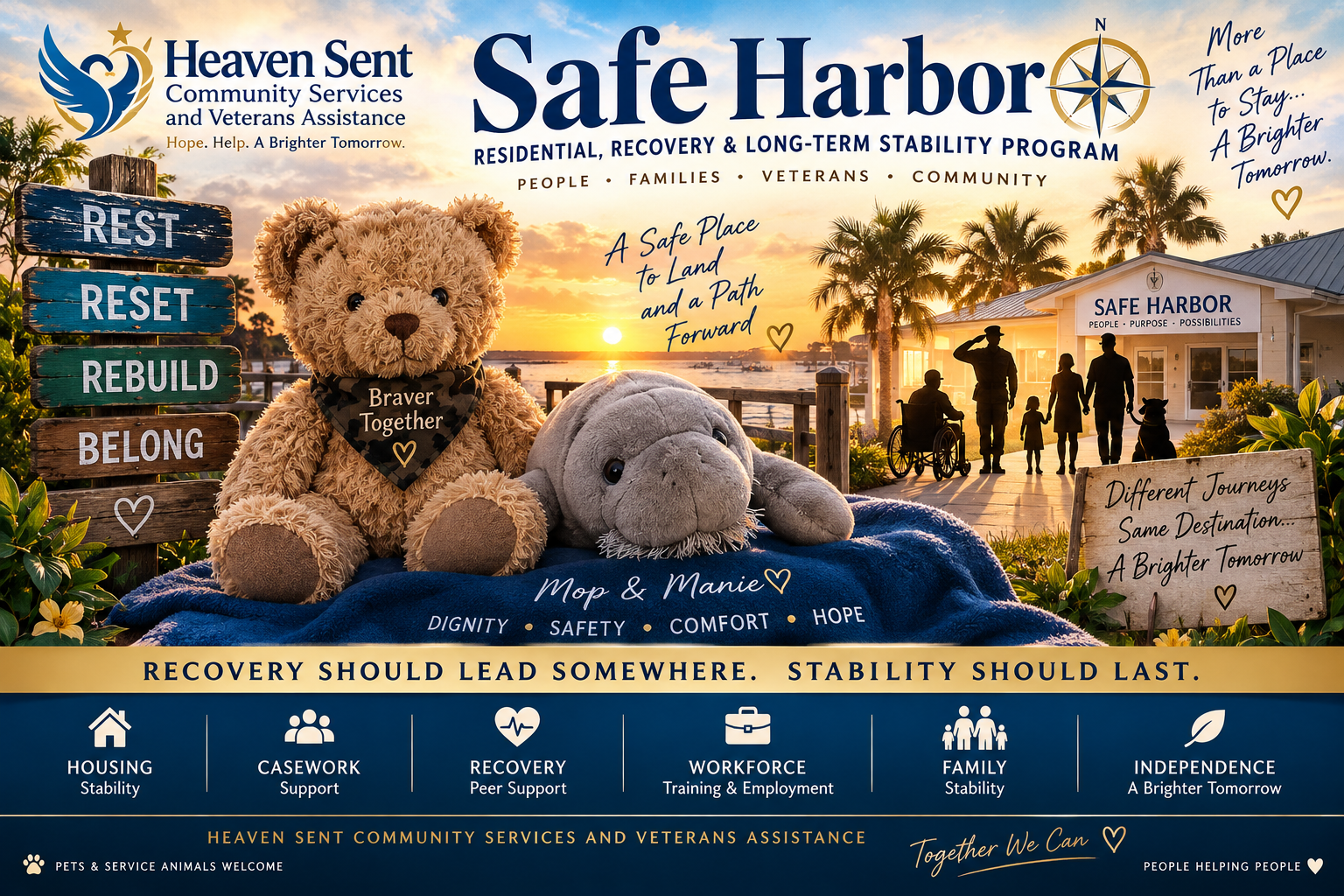
Mop, Heaven Sent's traditional tan teddy bear, represents comfort, dignity and the message that the person matters. Manie, Heaven Sent's soft gray manatee, represents Safe Harbor: calm, protection and a safe place to land while someone prepares for the next chapter.
They do not replace instructors, credentials, employers, licensed professionals or workforce agencies. They represent the culture the Academy is intended to protect while those systems do their work.
Built Responsibly, Not Oversold.
The Safe Harbor Workforce Academy is a planned and developing program. Specific classes, facilities, housing components, credentials, stipends, instructors, apprenticeships, schedules, and enrollment capacity are subject to funding, property acquisition, zoning, permitting, qualified staffing, training-provider agreements, licensing requirements, employer partnerships, and phased implementation.
Certification requirements vary by credentialing body, jurisdiction, provider, experience level, and occupation. The Academy will not represent an individual as licensed, certified, or qualified for regulated work unless the applicable requirements have actually been met.
Credibility Means Saying Exactly What the Academy Is—and What It Is Not.
Training & Credentials
Heaven Sent will distinguish internal instruction and documented competency from third-party certification, occupational licensure, college credit and Registered Apprenticeship. External credentials will be represented as earned only after the applicable issuing organization confirms completion.
Regulated electrical, plumbing, HVAC, CDL, pesticide, healthcare, equipment and other work will be taught, supervised or referred according to applicable laws, licensing rules and provider requirements.
Access & Individualization
The Academy is intended to support diverse participants, including Veterans, people with disabilities and people rebuilding after homelessness or other instability. Individual training plans, reasonable accessibility planning, supportive-service referrals and appropriate partner coordination will be incorporated as capacity and applicable program requirements allow.
No participant will be promised a job, wage, credential, benefit, grant, business loan, apprenticeship placement or housing outcome that Heaven Sent or a partner has not actually approved or secured.
Help Us Build the Training Pipeline.
Heaven-Sent is seeking employers, instructors, workforce agencies, apprenticeship sponsors, colleges, technical schools, unions, manufacturers, equipment donors, foundations, and community partners interested in helping build practical pathways from homelessness and instability to skill, credential, employment, and independence.
Joseph “Joe” Ryan
Founder & Executive Director
(407) 279-0520
(717) 623-0164
joepres@heaven-sent-veterans-outreach.org
Do Not Just Give Someone a Second Chance. Give Them the Tools to Build What Comes Next.
Housing can create breathing room. Foundational education can rebuild readiness. Training can create capability. Recognized credentials can document skill. Apprenticeship and work-based learning can connect instruction to an occupation. Employment can restore income and confidence. Entrepreneurship can create another path for the right participant. Follow-up can help protect the progress already made. Safe Harbor is being built to connect those pieces into one accountable pathway forward.