Heaven-Sent Safe Harbor Residence
25-Acre Master Plan – No Private Investors, Fully Grant & In‑Kind Funded
This page is designed as a banker‑ready overview and can be attached to any endorsement letter or support statement.
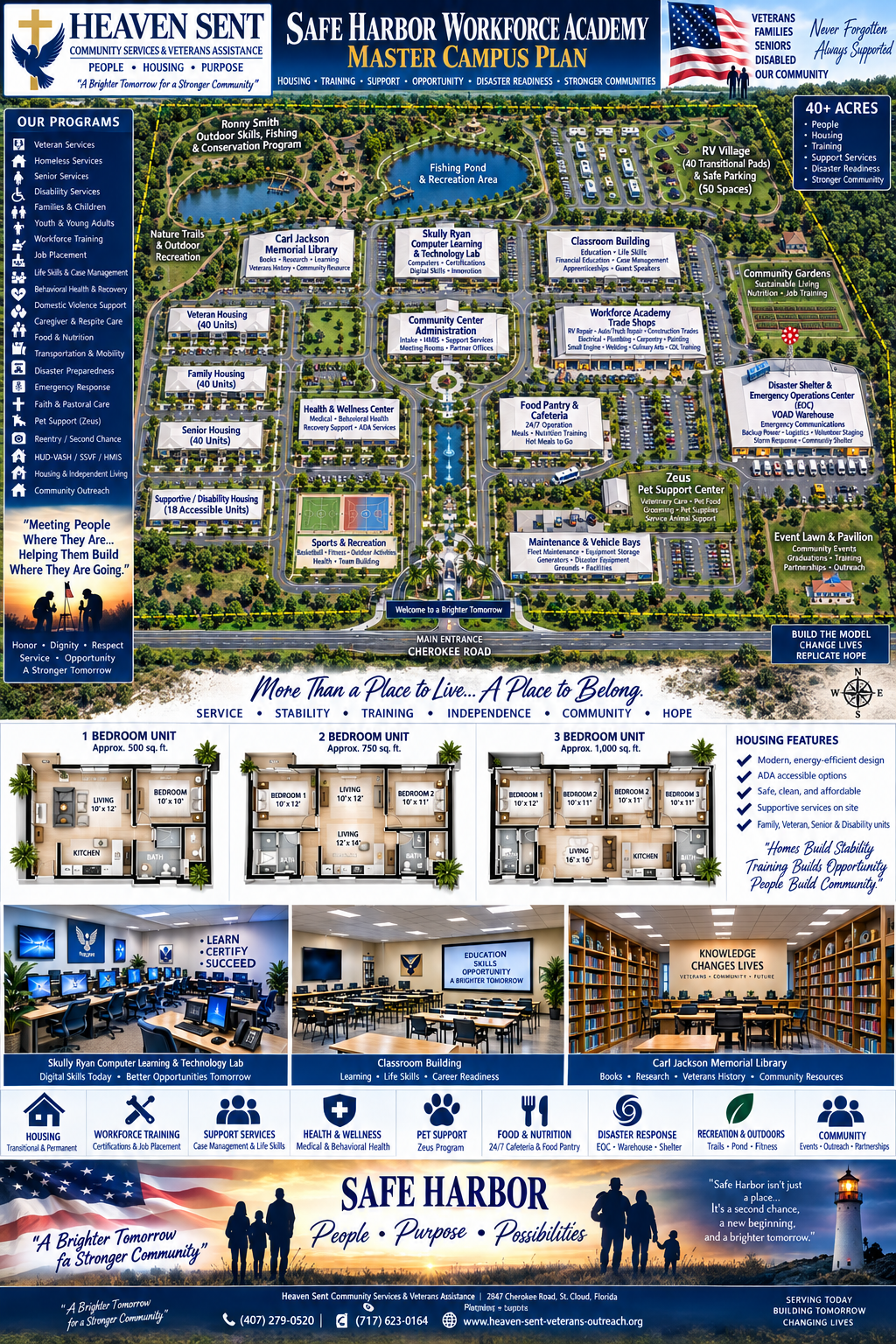
50 tiny homes, barracks, mess hall, school, vehicle triage, and 25 acres of hope for veterans, seniors, families, and disaster survivors.
365‑day calendar, 128 public funding sources, and a self‑sustaining operational model.
For Bankers & Community Leaders
Heaven-Sent Community Services and Veterans Assistance is not requesting private equity investment for this 25-acre Safe Harbor Residence. Our primary request from banks and community leaders is a letter of endorsement and support for this nonprofit affordable housing and supportive services campus, affirming that the project is financially sound, mission-aligned, and consistent with Florida’s surplus land and affordable housing statutes. Such a letter strengthens our position with public funders, foundations, and in-kind corporate partners as we execute this grant-funded, in-kind-heavy build-out.
If you support this vision, please share this page and consider providing a written endorsement on your letterhead. Even without extending credit, your public support can unlock additional grants, donated land, and in-kind resources needed to complete the Heaven-Sent Safe Harbor Residence campus for veterans, seniors, families, and disaster survivors.
Bottom Line – What the Bank Needs to See
Heaven-Sent Safe Harbor Residence is a 25‑acre campus with 50 tiny homes, 2 barracks, a 3‑classroom school, a 400‑seat mess hall, a vehicle triage center, admin/security, roads, utilities, solar, and rainwater systems. The entire campus can be built in one 12‑month stage, or in two stages over 24 months, using no private investor funds and relying instead on federal/state grants, corporate in‑kind, and disaster rebuild partners already mapped in our 365‑day calendar.
Project Value – Cash vs In‑Kind
The Safe Harbor Residence combines $20.4M in public cash funding with $2.2M in in‑kind donations of land, labor, materials, and services, for a total project value of $22.6M without private equity investment.
Scenario A – Single Stage, 25 Acres Completed in 12 Months
This scenario assumes Heaven‑Sent closes on the land, completes all site work, and builds out the entire campus in one continuous 12‑month construction schedule. At Month 12, residents are moving into all 50 homes and barracks, and every building is operational.
| Budget Item – Single Stage (25 Acres) | Cash Required | In‑Kind Value | Total Value |
|---|---|---|---|
| Site Development (25 acres – complete) | $600,000 | $0 | $600,000 |
| Infrastructure – Utilities (full build) | $1,250,000 | $0 | $1,250,000 |
| Infrastructure – Roads/Parking (200 spaces) | $500,000 | $0 | $500,000 |
| All 50 Tiny Homes (seniors, veterans, DV, families) | $10,000,000 | $0 | $10,000,000 |
| School Building (3 classrooms – Head Start/GED/ESL) | $750,000 | $0 | $750,000 |
| Mess Hall (complete with commercial kitchen) | $1,875,000 | $0 | $1,875,000 |
| Barracks (60‑bed emergency shelter) | $750,000 | $0 | $750,000 |
| Vehicle Triage Center (auto bays, wash, fleet) | $1,500,000 | $0 | $1,500,000 |
| Admin/Security Building (24/7 gate & office) | $500,000 | $0 | $500,000 |
| Solar Panel System (campus common areas) | $400,000 | $0 | $400,000 |
| Rainwater Harvesting System (20K gallons) | $200,000 | $0 | $200,000 |
| Land Donation (25 acres @ $50K/acre) | $0 | $1,250,000 | $1,250,000 |
| Architectural Services (In‑Kind) | $0 | $200,000 | $200,000 |
| Site Survey & Engineering (In‑Kind) | $0 | $100,000 | $100,000 |
| Legal Services – Land & Grants (In‑Kind) | $0 | $75,000 | $75,000 |
| Construction Materials (Lowe’s/Home Depot – In‑Kind) | $0 | $350,000 | $350,000 |
| Heavy Equipment Use (contractors, rebuild partners) | $0 | $150,000 | $150,000 |
| Landscaping Materials (nurseries, churches, civic) | $0 | $75,000 | $75,000 |
| Soft Costs (permits, insurance, contingency) | $2,075,000 | $0 | $2,075,000 |
| SINGLE STAGE TOTALS (12‑Month Build) | $20,400,000 | $2,200,000 | $22,600,000 |
Cash draw peaks during vertical construction (Months 7–9), then tapers as reimbursements and in‑kind support catch up.
Scenario B – Same 25 Acres in Two Stages (12 + 12 Months)
This option keeps the same 25‑acre master plan but splits construction into two logical stages. Stage 1 (Months 1–12) gets residents on campus fast. Stage 2 (Months 13–24) finishes the full build‑out. Combined totals equal the same $22.6M project value, but risk and cash flow are spread across two years.
Two-Stage Plan – Stage 1 vs Stage 2
The two-stage plan spreads the same $22.6M campus value across two years, with approximately $14.0M of total value in Stage 1 (including in-kind) and $8.6M in Stage 2, while keeping the combined cash requirement at $20.4M.
Stage 1 – First 12 Months (Residents Move In)
Stage 1 secures the 25 acres, completes all core infrastructure, builds the first 25 tiny homes, partial community buildings, and opens doors for the first residents by Month 12. Disaster rebuild partners and corporate donors provide most of the in‑kind lift in this stage.
| Stage 1 Budget Item | Cash Required | In‑Kind Value | Total Value |
|---|---|---|---|
| Site Development (25 acres – initial prep) | $400,000 | $0 | $400,000 |
| Infrastructure – Utilities (Phase 1) | $750,000 | $0 | $750,000 |
| Roads/Parking (100 spaces – Phase 1) | $300,000 | $0 | $300,000 |
| First 25 Tiny Homes | $7,500,000 | $0 | $7,500,000 |
| School Building (shell) | $400,000 | $0 | $400,000 |
| Mess Hall (foundation & partial build) | $1,000,000 | $0 | $1,000,000 |
| Admin/Security Building | $500,000 | $0 | $500,000 |
| Land Donation (25 acres) | $0 | $1,250,000 | $1,250,000 |
| Architectural Services (In‑Kind) | $0 | $200,000 | $200,000 |
| Site Survey & Engineering (In‑Kind) | $0 | $100,000 | $100,000 |
| Legal Services (In‑Kind) | $0 | $75,000 | $75,000 |
| Construction Materials – Lowe’s/Home Depot (Phase 1) | $0 | $200,000 | $200,000 |
| Heavy Equipment – Disaster Rebuild Partners (Phase 1) | $0 | $100,000 | $100,000 |
| Landscaping Materials (Phase 1) | $0 | $40,000 | $40,000 |
| Soft Costs (permits, insurance – Stage 1) | $1,150,000 | $0 | $1,150,000 |
| STAGE 1 TOTALS (Move‑In at 12 Months) | $12,000,000 | $1,965,000 | $13,965,000 |
Visual shows $12.0M cash vs. $1.97M in‑kind covering land and professional services to reduce borrowing.
Stage 2 – Months 13–24 (Full 25 Acres Completed)
Stage 2 finishes the campus: final 25 homes, complete school and mess hall, barracks, vehicle triage, and sustainability systems. Residents are already housed from Stage 1, and operating revenue from VA/USDA/HVRP helps stabilize cash flow during construction.
| Stage 2 Budget Item | Cash Required | In‑Kind Value | Total Value |
|---|---|---|---|
| Site Development (25 acres – completion) | $200,000 | $0 | $200,000 |
| Utilities Completion (Phase 2) | $500,000 | $0 | $500,000 |
| Roads/Parking – Additional 100 Spaces | $200,000 | $0 | $200,000 |
| Final 25 Tiny Homes | $2,500,000 | $0 | $2,500,000 |
| School Build‑Out (classrooms & lab complete) | $350,000 | $0 | $350,000 |
| Mess Hall Completion (full kitchen & seating) | $875,000 | $0 | $875,000 |
| Barracks (60‑bed shelter) | $750,000 | $0 | $750,000 |
| Vehicle Triage Center (full fit‑out) | $1,500,000 | $0 | $1,500,000 |
| Solar Panel System | $400,000 | $0 | $400,000 |
| Rainwater Harvesting System | $200,000 | $0 | $200,000 |
| Construction Materials Donation (Phase 2) | $0 | $150,000 | $150,000 |
| Heavy Equipment – Rebuild Partners (Phase 2) | $0 | $50,000 | $50,000 |
| Landscaping Materials (Phase 2) | $0 | $35,000 | $35,000 |
| Soft Costs (final permits, insurance – Stage 2) | $925,000 | $0 | $925,000 |
| STAGE 2 TOTALS (Campus Complete at 24 Months) | $8,400,000 | $235,000 | $8,635,000 |
Combined Stage 1 + Stage 2: Cash $20.4M, In‑Kind $2.2M, Total $22.6M – exactly the same as the single‑stage option, just phased for risk and cash flow.
Funding & In‑Kind Sources – No Private Investors
The 25‑acre campus is funded by a diversified mix of federal, state, corporate, foundation, and disaster‑rebuild programs with a heavy emphasis on in‑kind: land, food, materials, vehicles, equipment, and services. Private equity is not required in the plan you’ve already built in the 365‑day calendar and 128‑source funding sheet.
Federal & State Grants
- VA Grant & Per Diem (GPD) – bed nights for homeless veterans.
- DOL HVRP – veteran job training and auto tech programs.
- USDA Rural Dev & Emergency Food – kitchen build‑out and meals.
- FEMA Emergency Food & Shelter – disaster shelter operations.
- HUD / FHFC – capital and affordable housing programs.
Disaster Rebuild Partners
- Faith‑based rebuild teams providing volunteer labor & equipment.
- Tool & equipment donations from rebuild groups and unions.
- Reallocated materials from prior disaster deployments.
Corporate In‑Kind
- Lowe’s & Home Depot – materials, fixtures, and veteran grants.
- U.S. Foods, Sysco, Second Harvest – proteins, staples, meal support.
- AutoZone, O’Reilly, NAPA – parts and tools for vehicle triage.
- Healthcare partners – wellness and behavioral health supports.
Foundations & Faith Partners
- Regional/national foundations filling capital and program gaps.
- Churches providing landscaping, furnishings, and volunteers.
- Community sponsors underwriting tiny homes and classrooms.
Florida Nonprofit Housing Law – Banker’s Summary
1. Surplus Public Property Donations to Nonprofits – s. 274.05, Florida Statutes
Florida’s surplus property law allows a county or other governmental unit to classify land and other property as surplus when it is obsolete, uneconomical, or no longer needed for public use. Once classified as surplus, the governmental unit may offer that surplus property for sale or donation not only to other government agencies, but also to private nonprofit agencies as defined in state law.
This is the legal mechanism Heaven‑Sent will rely on when working with Osceola County, the City of Kissimmee, and other local entities to request donation of a 20–25 acre surplus parcel for use as an affordable supportive housing campus. The statute confirms that donating surplus property to a qualifying nonprofit is a valid public purpose.
2. Affordable Housing Land Donation & Density Bonuses – s. 420.615, Florida Statutes
Section 420.615, Florida Statutes, authorizes local governments to grant density bonus incentives to landowners who donate fee simple title in real property to the local government to assist in providing affordable housing. The donated land must be suitable for affordable housing and subject to deed restrictions to ensure permanent affordable use.
In simple terms, a private owner who donates land for affordable housing can be rewarded with the right to build more units than normally allowed on another parcel (a density bonus), creating a strong incentive for donation without requiring cash from the nonprofit. The law also allows the local government to transfer all or part of that donated land to a nonprofit housing organization for the production and preservation of permanently affordable housing, which is how a 25‑acre surplus/donated site can be conveyed to Heaven‑Sent for the Safe Harbor Residence.
3. Property Tax Treatment for Nonprofit Affordable Housing (Summary)
Florida provides property tax relief when land is owned entirely by a nonprofit 501(c)(3) and is predominantly used for affordable housing for households under specified income limits. This can include full or partial exemptions for qualifying affordable housing projects, which reduces long‑term operating costs and improves debt‑service coverage ratios for nonprofit housing providers like Heaven‑Sent.
How is Florida Statute 420.615 reflected on this page?
The statute is summarized in plain English above, with the citation “s. 420.615, Florida Statutes,” explaining that it gives density
bonus incentives to donors of land for affordable housing and lets local governments transfer that land to nonprofit housing
organizations. This gives bankers a clear legal anchor while attorneys can review the statute directly.
What density bonuses does 420.615 provide to donors?
The law allows a local government to approve a higher residential density than normally permitted (a bonus) on a donor’s separate
development site when the donor gives fee simple title to land that will be used for affordable housing; the exact number of bonus units
is set in the local government’s implementing ordinance and comprehensive plan.
Are nonprofit projects already using donated land and surplus land tools in Florida?
Yes. Across Florida, nonprofit housing providers and community land trusts have used surplus land programs and local affordable
housing land donation ordinances to develop rental and ownership units on donated public land, often paired with state and federal
subsidy layers; statewide guides on surplus lands and recent legislative changes describe these models as best practice.
24‑Month Master Calendar – Single Stage vs Two Stages
This calendar grid shows, month by month, how the campus is executed in a single 12‑month build versus the two‑stage 24‑month plan, using the same 365‑day instruction set and 128‑source funding schedule you already documented.
| Month | Single Stage (All 25 Acres in 12 Months) | Two‑Stage Plan – Stage 1 (Months 1–12) | Two‑Stage Plan – Stage 2 (Months 13–24) |
|---|---|---|---|
| Months 1–3 – Land, Grants, Design | |||
| Month 1 |
Single Stage:
Launch land hunt (Osceola surplus, CRA, probate), 128‑source funding calendar live.
Intro calls with VA, USDA, HVRP, FEMA, HUD, FHFC; architect retained.
|
Two‑Stage – Stage 1:
Same land and grant launch, tagged as Stage‑1 priority for first 25 homes.
Begin MOUs with food and materials partners for Stage‑1 operations.
|
Stage 2:
Stage‑2 grants pre‑scoped and added to 24‑month calendar.
|
| Month 2 |
Single Stage:
Submit first capital grants (VA GPD, USDA, HVRP, FEMA, HUD, FHFC).
Open Lowe’s / Home Depot veteran housing portals; finalize draft site plan PDF.
|
Two‑Stage – Stage 1:
Same grant submissions, but with Stage‑1 construction schedule included.
Lock U.S. Foods, Sysco, Second Harvest MOUs for early operations.
|
Stage 2:
Outline Stage‑2 specific capital (school completion, barracks, triage, solar).
|
| Month 3 |
Single Stage:
Land LOIs in hand; 25‑acre pro forma and phasing plan completed.
Pre‑application meetings with zoning/permitting agencies.
|
Two‑Stage – Stage 1:
Same land/zoning track; define which homes and buildings are Stage‑1 vs Stage‑2.
Fix Stage‑1 12‑month construction calendar.
|
Stage 2:
Forecast Stage‑2 start (Month 13) and resource needs.
|
| Months 4–6 – Land Deed, Permits, Groundbreaking | |||
| Month 4 |
Single Stage:
Land deeded to Heaven‑Sent; entire 25‑acre site approved for affordable campus.
Zoning/building permits submitted; construction docs 90% complete.
|
Two‑Stage – Stage 1:
Same land deed & entitlement; Stage‑1 GC contract executed.
Order first homes and utilities packages for Stage‑1 footprint.
|
Stage 2:
Stage‑2 design refined; value engineering based on Stage‑1 bids.
|
| Month 5 |
Single Stage:
Site clearing, grading, erosion control across all 25 acres.
Main utility lines (water, sewer, electrical) trenching begins.
|
Two‑Stage – Stage 1:
Clear entire 25 acres, but prioritize utilities for first 25 homes and admin/mess shell.
Lowe’s/Home Depot material donations flow to Stage‑1 work.
|
Stage 2:
Coordinate with suppliers for Stage‑2 pipeline starting Month 13.
|
| Month 6 |
Single Stage:
Road base and first parking lots installed; underground utilities 50% complete.
Footings poured for mess hall, school, admin, barracks, and triage center.
|
Two‑Stage – Stage 1:
Same, with concrete and utilities focused on 25 homes + core buildings.
Stage‑1 inspections scheduled; Stage‑2 remains in pre‑construction.
|
Stage 2:
Stage‑2 funding decisions start arriving; cashflow model updated.
|
| Months 7–12 – Building Up & Moving In | |||
| Month 7 |
Single Stage:
Vertical construction of 50 homes, mess hall, school, admin, barracks, triage.
Solar pad and rainwater tanks set.
|
Two‑Stage – Stage 1:
Vertical construction on first 25 homes, admin, mess hall shell, school shell.
Stage‑1 roads/parking and utilities fully functional.
|
Stage 2:
Pre‑construction meetings for Stage‑2 GC and trades.
|
| Month 8 |
Single Stage:
Interior build‑out campus‑wide; vehicle triage building enclosed.
|
Two‑Stage – Stage 1:
25 homes close to interior completion; admin/mess interiors advanced.
Appliances/furnishings ordered (in‑kind where possible).
|
Stage 2:
Stage‑2 schedule finalized and slotted into Months 13–24.
|
| Month 9 |
Single Stage:
Campus finishes, fixtures, systems commissioning, and initial landscaping.
|
Two‑Stage – Stage 1:
Finishes on 25 homes, admin, and partial mess/school areas.
Stage‑1 punch list started.
|
Stage 2:
Stage‑2 contracts signed; procurement for remaining 25 homes and barracks.
|
| Month 10 |
Single Stage:
Final inspections for 50 homes and all buildings; life safety systems tested.
Staff training and dry‑run operations.
|
Two‑Stage – Stage 1:
COs for 25 homes and core buildings; intake process begins.
|
Stage 2:
Permits confirmed for Stage‑2 vertical work.
|
| Month 11 |
Single Stage:
Furniture installed; final landscaping, signage, and move‑in prep.
|
Two‑Stage – Stage 1:
Soft opening; early residents move into completed homes.
Protocols adjusted from first weeks of live operation.
|
Stage 2:
Stage‑2 contractors mobilize and stage materials.
|
| Month 12 |
Single Stage:
Grand opening: entire 25‑acre campus fully operational.
VA, USDA, HVRP, FEMA billing cycles begin.
|
Two‑Stage – Stage 1:
Stage‑1 complete: 25 homes + core buildings fully in use.
Operating revenue begins from public sources.
|
Stage 2:
Final Stage‑2 prep; ready to start full construction Month 13.
|
| Months 13–24 – Stage 2 Build‑Out (Two‑Stage Plan Only) | |||
| Months 13–18 |
Single Stage:
Campus already complete; focus shifts to stabilizing operations and outcomes.
|
Two‑Stage – Stage 1:
Stage‑1 residents housed; data and outcomes for funders gathered.
|
Stage 2:
Vertical construction for final 25 homes, barracks, mess/school completion, triage center.
Solar and rainwater systems connected across campus.
|
| Months 19–24 |
Single Stage:
Full operations for 110 residents; program expansion and reserves building.
|
Two‑Stage – Stage 1:
Stage‑1 operations steady; waiting list feeds into new Stage‑2 units.
|
Stage 2:
Stage‑2 complete: full 25‑acre campus identical to single‑stage outcome.
All 50 homes, barracks, mess hall, school, triage, and utilities fully operational by Month 24.
|
Please pass this page along to anyone who may be able to offer an endorsement letter, land donation, grant support, or in-kind contributions to help us achieve this goal.
Contact Heaven-Sent Safe Harbor Team
For endorsement letters, questions from bankers, potential land donors, or grant partners, please use the form below or email us directly.