
SAFE HARBOR MASTER PROGRAM
Housing • Workforce • Support • Disaster Readiness • Opportunity
FROM OUTREACH TO STABILITY — FROM STABILITY TO OPPORTUNITY
Heaven Sent Meets People Where They Are. Safe Harbor Helps Them Build Where They Are Going.
Heaven Sent's work does not begin at the gates of a campus. Street outreach, food and feeding, client casework, Veterans assistance, housing navigation, transportation, disaster response, pastoral care, and support for seniors, people with disabilities and families continue in the community. Safe Harbor is the next step.
Homelessness Is Not One Population — And It Does Not Have One Cause.
The 2026 Point-in-Time Count provides a one-night snapshot across Orange, Osceola and Seminole Counties. PIT data are widely recognized as a planning tool and may undercount the full population experiencing homelessness.
Orange + Osceola + Seminole, 2026 PIT
Streets, woods, vehicles and other unsheltered locations
More than four in ten of the region's homeless population
2026 regional PIT total compared with three years earlier
2026 Central Florida PIT Count by County
Source: Homeless Services Network of Central Florida, 2026 PIT Count.
Where the 2,724 People Were Counted
Unsheltered Homelessness Is Also a Vehicle-Housing Issue
HSN reported 993 people living on streets, in woods or in cars during the January 2026 count.
A Percentage Increase Can Look Very Different in Actual Dollars.
Social Security's 2026 COLA was 2.8%. The adjustment matters — but for people beginning with limited monthly income, the actual additional dollars must absorb changes across housing, food, utilities, transportation, healthcare and other necessities.
2026 federal maximum.
+$27/month from 2025
Estimated average Social Security benefit after 2026 COLA.
+$45/month
Estimated average benefit after 2026 COLA.
+$57/month
What the 2.8% COLA Meant in Monthly Dollars
Source: Social Security Administration. These figures illustrate the dollar effect of the 2026 COLA; individual benefits vary.
Low-Income Households Experience Inflation as Bills — Not as Percentages.
A senior, Veteran, person with a disability or working family does not purchase “the CPI.” The household pays rent, electricity, groceries, transportation, insurance, healthcare and prescriptions. Specific expenses can rise faster or slower than the overall inflation measure.
Latest 12-Month BLS Reading
The August 2026 national CPI reading showed electricity prices 3.8% above a year earlier.
Latest 12-Month BLS Reading
National rent inflation remained positive in the August 2026 CPI.
Latest 12-Month BLS Reading
Healthcare remains one of the essential expenses competing for limited household income.
BLS figures above are national CPI-U category changes for the 12 months ending August 2026. They are not presented as Central Florida household bills and should not be interpreted as every household's personal rate of increase.
Working Does Not Automatically Mean Qualifying for Housing.
Some landlords and property managers use gross-income screening benchmarks such as three times monthly rent. It is not a universal legal requirement, but where used, the math can create a substantial barrier.
Monthly Income Compared With a $5,700 Example Screening Threshold
Today's Housing Instability Can Become Tomorrow's Senior Homelessness.
Research summarized by the UCSF Benioff Homelessness and Housing Initiative projects that the proportion of people age 65 and older experiencing homelessness in the United States could triple between 2017 and 2030.
Projected Growth in Age 65+ Homelessness
This is a national research projection, not a prediction of the exact Central Florida senior homeless population.
Premature Aging Matters
UCSF reports that adults experiencing homelessness in their 50s and 60s can have health status similar to people roughly 20 years older in the general population.
Why Safe Harbor Includes Senior & Disability Support
Housing instability can become more difficult to escape as mobility, chronic health conditions, disability and fixed-income constraints increase. Safe Harbor is designed to intervene before instability becomes prolonged or chronic homelessness.
Accessibility Is Not an Add-On. It Is Part of the Housing Model.
Disability can affect income, transportation, employment options, healthcare costs and the type of housing a person can safely use. Safe Harbor is designed to account for those realities from the beginning.
Average Disabled Worker Benefit
Estimated average monthly Social Security disabled-worker benefit after the 2026 COLA.
Maximum Federal SSI
Maximum 2026 federal SSI payment for an eligible individual, before reductions that may apply based on countable income.
Accessible / Adapted Homes
Safe Harbor's current planning model includes at least 18 accessible/adapted homes within the 120 permanent-home total.
Homelessness Does Not Always Look Like a Tent.
Employment, a car, van, camper or RV can reduce some immediate dangers, but none automatically provides affordable, stable and permanent housing.
EMPLOYED DOES NOT ALWAYS MEAN HOUSED.
A person can work and still face rent levels, screening standards, deposits, credit requirements, transportation costs and household expenses that keep conventional housing out of reach.
A VEHICLE IS NOT THE SAME AS PERMANENT HOUSING.
Federal homelessness measurement recognizes people sleeping in vehicles and other places not meant for human habitation as part of unsheltered homelessness.
STABILIZATION CAN BE THE BRIDGE.
Safe parking and RV transitional spaces can create an organized point of contact for case management, housing navigation, employment support and movement toward permanent housing.
Progress Proves Intervention Can Work — The Mission Is Not Finished.
National Veteran homelessness has fallen substantially. That progress demonstrates the value of coordinated housing and service interventions while also showing the remaining need.
Veterans Experiencing Homelessness
January 2025 national PIT snapshot.
Unsheltered Veterans
Living in places not meant for human habitation.
Since 2010
National estimated Veteran homelessness declined 56.1% from 2010 to the January 2025 PIT count.
Housing Affordability Is Not Just a Homelessness Issue.
Homeownership costs and rents influence the entire housing system. When households cannot purchase, more remain in the rental market. When lower-income renters cannot compete, housing instability can deepen.
Q2 2026
U.S. Census Bureau / HUD national median sales price for new houses sold. This is a national benchmark, not a Central Florida home-price estimate.
Why the Ten-Year Story Matters
A credible proof-of-need case should examine housing costs over time, not select a single unusually high or low month. Safe Harbor uses official housing, income and benefit data to show how long-term affordability pressures affect different populations.
Safe Harbor Is Designed Around the Household Economy — Not Just the Housing Unit.
Stable housing is connected to food, transportation, employment, healthcare, disability accessibility, case management, benefits, education, disaster resilience and the ability to remain housed after placement.
Safe Harbor Connects Problems That Are Too Often Addressed Separately.
The program is designed as a coordinated pathway rather than a collection of disconnected services.
Housing Cost Burden
Response: permanent affordable housing plus housing navigation and stabilization.
Vehicular Homelessness
Response: safe parking, RV transitional spaces, sanitation and case-management pathways.
Senior Housing Instability
Response: affordable housing, accessibility, benefits navigation and senior support.
Disability
Response: adapted housing, disability services, accessibility and employment pathways where appropriate.
Veteran Homelessness
Response: outreach and connection to VA, HUD-VASH, SSVF and other eligible Veteran resources.
Working Homelessness
Response: stabilization, housing navigation, workforce development and pathways to increased earnings.
Food Pressure
Response: food and nutrition services, cafeteria and community feeding capacity.
Transportation Barriers
Response: coordinated transportation supporting employment, healthcare, benefits and housing access.
Disaster Vulnerability
Response: resilient shelter, warehouse/logistics, communications, feeding and emergency-response capability.
Multiple Housing Pathways. One Coordinated Campus Model.
One Campus. Multiple Systems Working Together.
The graphic below is a conceptual planning illustration. Final unit counts, placement, engineering, utilities, roads, stormwater, fire access, zoning and construction are subject to site-specific professional design and governmental approvals.
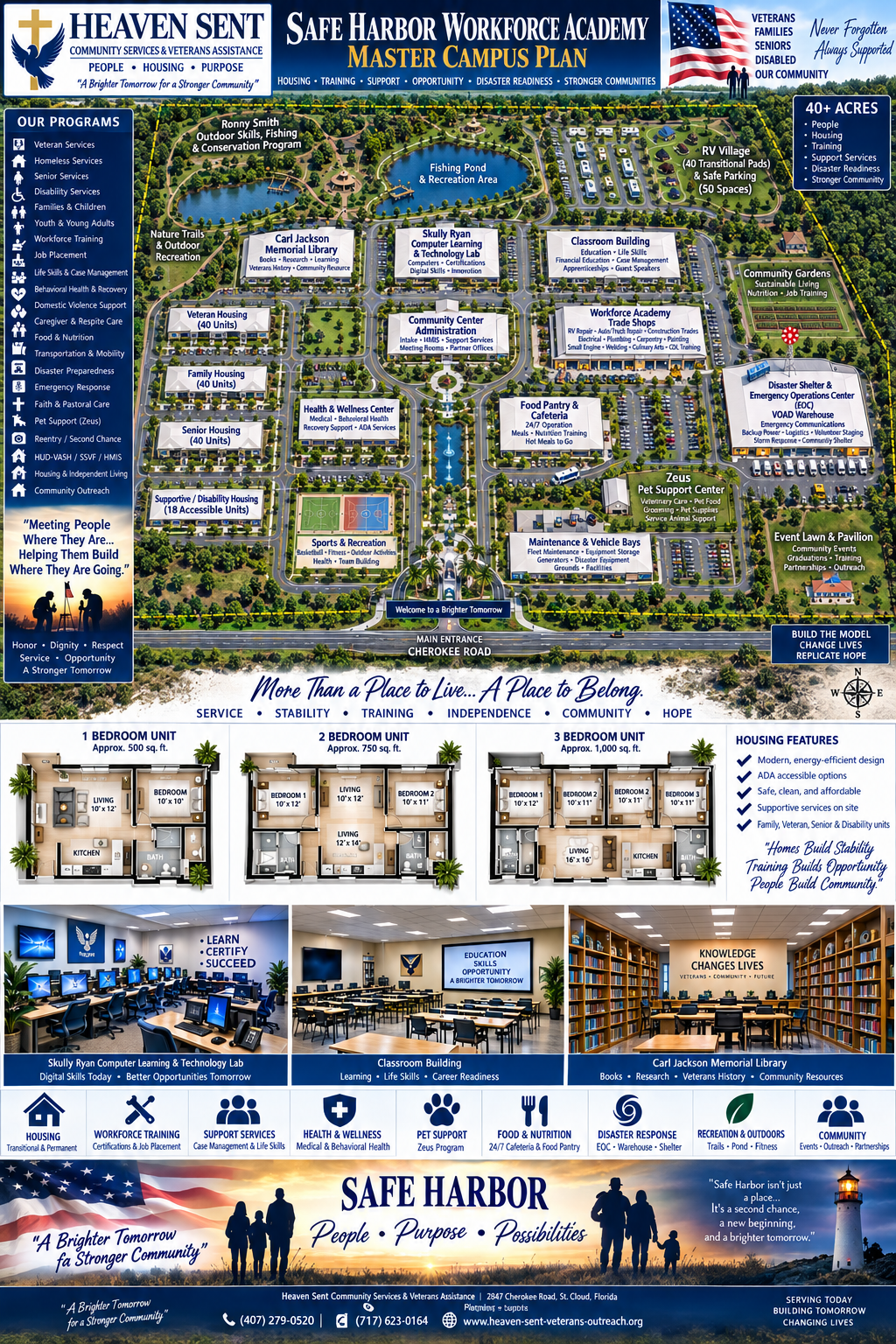
IMPORTANT: The authoritative current planning capacity is the written capacity shown above: 120 permanent affordable homes total, with accessible/adapted homes included within that total. The conceptual illustration is not a final engineering plan.
Housing Stabilizes the Present. Skills Can Help Change the Future.
Workforce participation is individualized and is not a condition for emergency food, safety or housing assistance.
Construction Trades
Maintenance, carpentry, electrical pathways, masonry, painting and related skills.
Automotive & RV
Automotive, truck, RV and small-engine training pathways.
Food & Hospitality
Cooking, food preparation, nutrition and service skills.
Technology
Computer learning, digital skills and technology access.
Disaster Response
Preparedness, logistics, feeding, communications and field experience.
Employment Pathways
Apprenticeship, certifications, employer connections and job-placement support.
Do Not Ask One Funding Source to Build Everything.
Safe Harbor is designed around a layered capital and operating strategy in which each eligible source supports the costs it is legally and programmatically permitted to fund.
Land & Predevelopment
Philanthropy, local resources, recoverable grants, CDFI/predevelopment capital and other eligible sources.
Permanent Affordable Housing
SHIP, HOME, CDBG where eligible, Florida Housing programs, Housing Credits, SAIL, local resources, CDFI/bank participation and philanthropy.
Homelessness Stabilization
HUD CoC, ESG, local homelessness resources and philanthropy where eligible.
Veterans
VA and Veteran partner pathways including HUD-VASH, SSVF, HVRP where eligible and Veteran service organizations.
Workforce
DOL/WIOA partner routes, CareerSource, employers, Registered Apprenticeship pathways and foundations.
Food & Nutrition
USDA/partner routes, food banks, healthcare partners, foundations, corporate and in-kind support.
Disaster Resilience
Local emergency management, eligible state/federal partner routes, mitigation/preparedness resources, philanthropy and corporate support.
Technology
Eligible community-development resources, financial institutions, technology companies, foundations and in-kind equipment.
Transportation
Transit, healthcare, Veteran, workforce, philanthropic and vehicle-donation pathways.
Funding sources shown are potential or eligible pathways only. They are not represented as awards, commitments or guarantees unless separately documented.
Build What Is Needed. Measure It. Expand Responsibly.
Predevelopment
Site control, due diligence, feasibility, surveys, environmental review, design, legal and approvals.
Stabilization Core
Initial permanent housing, safe parking/RV capacity, Resource Center, food, workforce and warehouse components.
Housing & Workforce Expansion
Additional permanent homes, trade shops, transportation and expanded workforce capacity.
Disaster & Resilience
Hardened shelter, logistics warehouse, communications/EOC functions and resilient infrastructure.
Ultimate Buildout
Up to 120 permanent homes, 24 cottages and completion of the integrated campus model, subject to feasibility and funding.
Community Outreach
Heaven Sent continues direct outreach, casework, feeding, Veteran services, transportation and disaster work throughout development.
Build the Model. Measure the Outcomes. Replicate What Works.
Safe Harbor is being designed as a distinctive integrated model — bringing together functions that are frequently addressed separately within one coordinated pathway.
One Architecture. Local Adaptation. National Potential.
The goal is not to copy one building 50 times. The goal is to document a repeatable program architecture that communities can adapt to local homelessness needs, property conditions, zoning, Continuum of Care systems, healthcare networks, workforce systems, funding opportunities and governmental requirements.
Future chapters or replication efforts remain subject to applicable federal, state and local nonprofit, charitable-solicitation, employment, housing, licensing, zoning, funding and program requirements.
Intervene Before Housing Instability Becomes Chronic Homelessness.
The question is not simply whether America can afford to intervene.
Safe Harbor asks communities to examine the human and financial consequences
of waiting until a working family, Veteran, senior or person with a disability
has already fallen into chronic homelessness.
You Do Not Have to Fund All of Safe Harbor.
Help Build Your Piece of Safe Harbor.
Banks • CDFIs • Foundations • Government • Corporations • Manufacturers • Healthcare • Employers • Developers • Landowners • Faith Communities • Professional Firms • In-Kind Partners
Financial Institution
Housing capital, community-development finance, predevelopment and eligible CRA-aligned opportunities.
Foundation
Housing stability, disability, seniors, families, Veterans, workforce, food, transportation and measurable outcomes.
Corporation
Equipment, technology, vehicles, construction materials, food, furnishings, professional services and workforce partnerships.
Government / Grantmaker
Eligible housing, homelessness, workforce, Veteran, resilience and community-development components.
Joseph “Joe” Ryan
Founder & Executive Director
Heaven Sent Community Services & Veterans Assistance
Office:
(407) 279-0520
Cell:
(717) 623-0164
Email:
joepres@heaven-sent-veterans-outreach.org
Data Sources & Important Notes
Heaven Sent believes a strong case for community investment should distinguish documented facts from planning assumptions. Statistics on this page are presented with their applicable geography and reporting period wherever practical.
- Central Florida 2026 PIT: Homeless Services Network of Central Florida — 2026 Point-in-Time Count Results .
- Social Security / SSI / 2026 COLA: Social Security Administration — 2026 COLA Fact Sheet .
- Veteran Homelessness: U.S. Department of Veterans Affairs — National Veteran PIT Count .
- Older Adult Homelessness: UCSF Benioff Homelessness and Housing Initiative — national research on aging and homelessness.
- Consumer Prices: U.S. Bureau of Labor Statistics, Consumer Price Index.
- New-Home Price Benchmark: U.S. Census Bureau / U.S. Department of Housing and Urban Development, New Residential Sales.
PIT counts are one-night estimates and do not represent every person who experiences homelessness during a year. National figures should not be interpreted as Central Florida-specific estimates. Research projections are identified as projections. Illustrative rent-screening calculations are examples and do not represent a universal landlord requirement.
Safe Harbor remains a developing program. Campus illustrations, costs, development phases, funding pathways and capacities are planning materials subject to due diligence, site control, professional architecture and engineering, zoning and land-use review, environmental review, governmental approvals, underwriting, funding availability and Board authorization. Mention of a government program, corporation, nonprofit or funding source does not represent an award, endorsement, partnership or commitment unless separately documented.
Restricted funds will be used in accordance with applicable award terms, approved budgets, donor restrictions, contracts and law. Costs, staff time, assets and services will not be billed twice to multiple funding sources.
© 2026 Heaven Sent Community Services & Veterans Assistance. Original Safe Harbor written and graphic materials. All rights reserved.